 NutriThrive
Curry Leaves Health Benefits: The Evidence
Curry leaves have real nutritional benefits beyond flavour. Here's what's actually backed by evidence. Practical Australian guidance from NutriThrive.
Quick Answer
Curry leaves are primarily a culinary herb from Murraya koenigii. They contain nutrients and plant compounds. Some of those compounds, and curry-leaf extracts, have been investigated in laboratory and animal research. Human evidence for specific health outcomes is limited. Research that uses extracts, isolated compounds, animals or large experimental doses does not prove that eating ordinary dried curry leaves produces the same effects. Treat dried curry leaves as food, not medicine.
Most people who cook South Asian food keep curry leaves in the kitchen, and many remove them before eating. This article is about what that actually means: what is known as food nutrition, what sits at animal or lab level, and what a culinary serving of dried leaves does not prove.
How to read the evidence
Claims about curry leaves get mixed together online. This page uses five levels:
- A. Human evidence, studies in people. For curry leaves, this is limited, and this article does not name trials we cannot source here.
- B. Animal evidence, useful for generating questions, not proof of an effect in a human kitchen.
- C. Lab / in-vitro evidence, compounds tested in a dish or on isolated systems, not a cooked meal.
- D. Traditional use, long kitchen and Ayurvedic practice. Tradition is not a clinical trial.
- E. Basic food / nutrition information, the plant can contain certain nutrients and compounds. That is not the same as a proven health outcome, especially at the amounts used in cooking.
What’s in curry leaves as food
Evidence level: E (food composition), plus C where researchers have studied individual compounds.
Curry leaves are a leaf herb. Analyses of the plant have reported nutrients such as plant iron, beta-carotene, vitamin C, calcium and fibre, and plant compounds including carbazole alkaloids. That is composition, not a dose from a typical tadka.
A handful of leaves in a family pot of dal is a small amount of plant matter. It should not be framed as a clinically meaningful iron or vitamin dose, and it is not a treatment for anaemia, eye disease or low immunity. Plant iron is non-haem iron; absorption depends on the rest of the meal. None of that turns curry leaves into a supplement.
Extracts vs ordinary dried leaves
Much of the research people cite does not use the same thing you put in a pan.
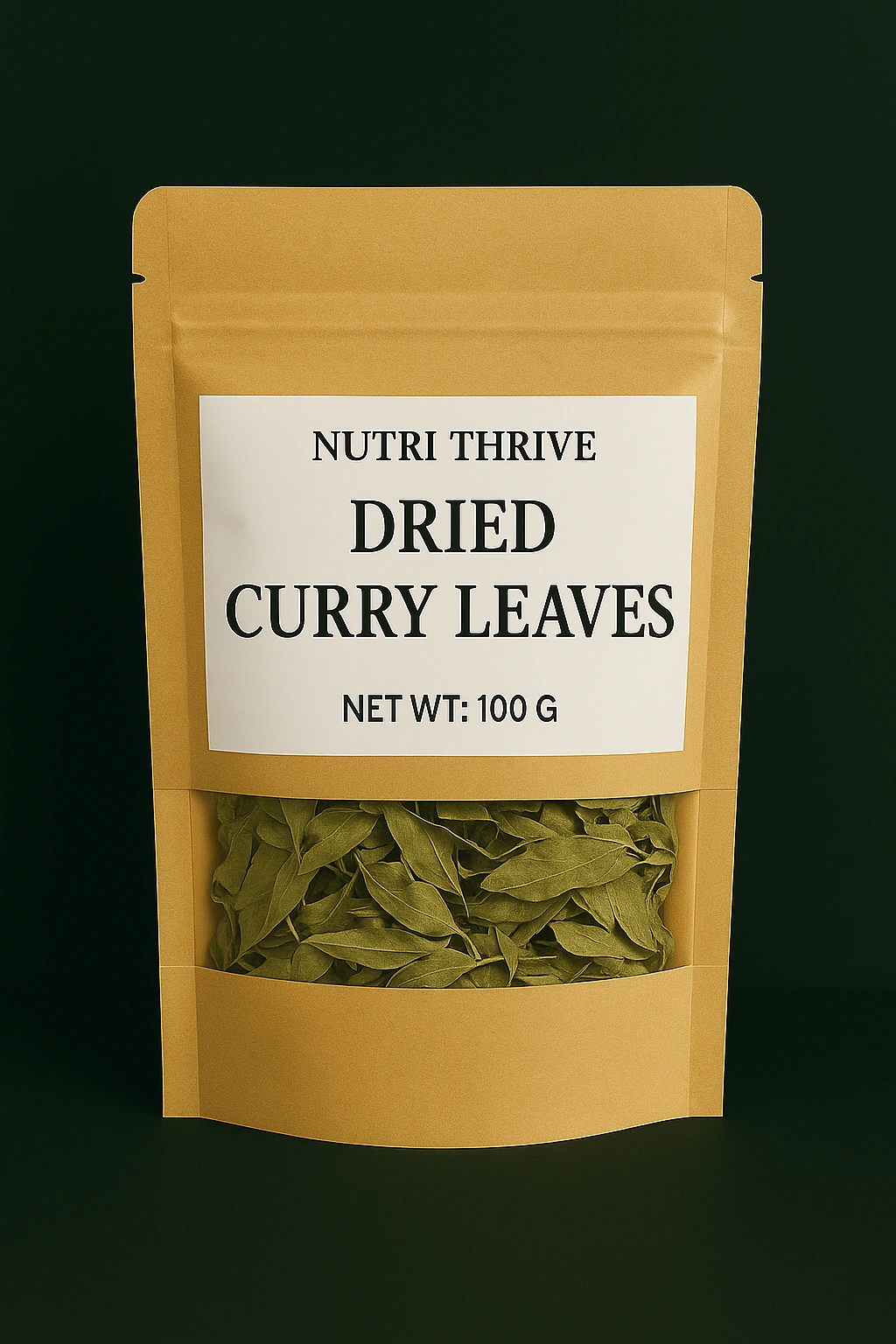
Work involving extracts, isolated carbazole compounds, curry-leaf powder, fresh leaves, animal doses or laboratory experiments cannot automatically be applied to an ordinary culinary serving of dried curry leaves. Drying, storage, cooking fat, how long the leaves cook, and whether you eat them or pick them out all change what ends up in the dish. NutriThrive’s dried curry leaves are a culinary ingredient. They are not an experimental extract, and they should not be assumed to reproduce laboratory or animal findings.
What research has looked at
Plant compounds and “antioxidants”, levels C and E. Curry leaves contain plant compounds that have been studied in the lab for antioxidant activity. That is not the same as a proven human health outcome. Presence of those compounds, or activity in a test, does not make a culinary benefit “well established.”
Inflammation, not established here. Laboratory or animal work on isolated compounds is not evidence that eating dried curry leaves reduces inflammation in people. This page does not treat anti-inflammatory effects as a demonstrated outcome.
Cholesterol and heart, mostly B; human evidence limited. Animal research has looked at cholesterol-related markers. That does not show that ordinary dried culinary leaves reduce LDL or raise HDL in people. For the longer discussion, see curry leaves for heart health and cholesterol. Curry leaves are not a cholesterol treatment.
Blood sugar, not a diabetes treatment. This page does not claim that curry leaves improve insulin sensitivity, slow carbohydrate absorption, or prevent, treat or manage diabetes. Animal or extract findings, if they exist elsewhere, do not establish that for food-level dried leaves. Anyone with diabetes should follow medical advice, not a herb article.
Digestion, level D. Curry leaves have a long traditional use around meals in South Asian cooking and Ayurvedic practice. That is tradition. It is not proof of a clinical digestive benefit.
Hair use is a separate question: see can you use dried curry leaves for hair. For a tea method, see how to make curry leaf tea.
Eat the leaves, or temper and remove them?
This is the practical question in a lot of Australian kitchens.
Tempering, adding curry leaves to hot oil or ghee at the start, is how the aroma shows up in dal, sambar and similar dishes. Heat carries flavour into the fat, so even if you pick the leaves out later, the dish still tastes of them. You get less of the actual leaf than if you eat them.
Leaving the leaves in, simmering them into a sauce, or blending them into a chutney means you eat the leaf itself. That is more of the plant in the meal. It is still food, not a measured dose. Using curry leaves regularly in cooking is a reasonable part of a varied diet. It is not a reason to treat them as a daily medicinal fix.
Dried vs fresh in Australian kitchens
Fresh curry leaves are not reliably stocked everywhere in Australia. Dried leaves keep for months in a sealed container and are the practical pantry option for weekly cooking. Fresh still wins for finishing and for dishes where the leaf is the point.
Drying and storage can change aroma and some plant components. Research on fresh leaves or extracts cannot simply be transferred to dried culinary leaves. This page does not quote a retention percentage. For buying, storing and tempering, see dried curry leaves in Australia.
Cook with our dried curry leaves, free AU shipping over $79 when you mix with moringa powder or Darjeeling tea.
FAQ
Are curry leaves actually good for you?
They are a cooking herb with nutrients and plant compounds. That is food. Human evidence for specific health outcomes is limited. They are not a reason to skip medical care.
Are dried curry leaves as nutritious as fresh?
Not as a simple yes. Drying and storage can affect aroma and some components. Research on fresh leaves or extracts does not automatically apply to dried culinary leaves.
Can curry leaves lower cholesterol?
Ordinary dried culinary leaves should not be treated as a cholesterol-lowering treatment. For the dedicated discussion, see curry leaves, heart health and cholesterol.
Can curry leaves lower blood sugar?
They should not be used as a diabetes treatment or as a substitute for medical care. This page does not claim they lower blood sugar in people who cook with dried leaves.
Do you eat curry leaves or remove them after cooking?
Either is normal. Tempering in hot oil is for flavour; eating the leaves means you consume more of the leaf. Neither turns them into medicine.
Written by Neer, Founder, NutriThrive Australia.
Looking for dried curry leaves for cooking?
NutriThrive dried curry leaves are sold as a culinary ingredient.
Last updated: 31 August 2026
Update history
- 31 Aug 2026: Tightened evidence language; separated food from extract/animal research; removed unsourced outcome claims.
- June 2026: Initial publication.

A practical next step
Dried Curry Leaves
Farm-grown karipatta from our own farm.
$7.00 / 30g