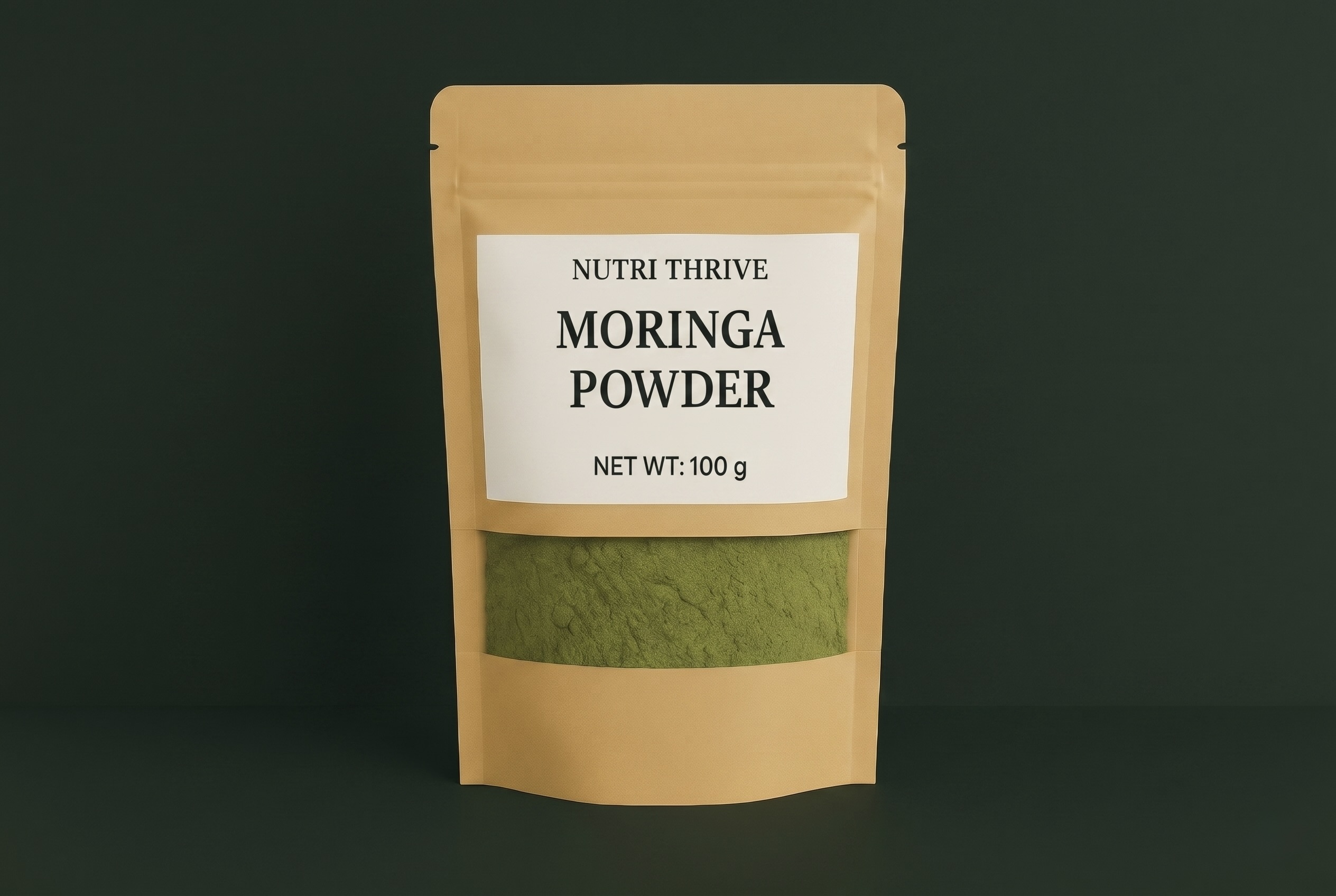
Something changed in Australian health searches in 2026. Berberine went from niche supplement forums to Chemist Warehouse aisles. Moringa kept growing. Then the two collided — "moringa berberine" became one of the fastest-rising search phrases in the country.
Buy moringa powder Australia — NutriThrive $11/100g, NMI lab-tested, same-day Melbourne dispatch →
That kind of growth usually means one of two things: either something genuinely useful is being discovered by mainstream audiences, or a marketing wave has arrived and is outrunning the evidence. In this case, it's a bit of both — and knowing which is which is exactly what this article is for.
We're going to go through berberine and moringa separately, honestly and carefully, then look at what combining them actually means. We'll call out the things that are real, the things that are overstated, and the trending product in this space (berberine patches) that has essentially no clinical basis at all.
No miracle claims. No fake celebrity endorsements. Just what the research says, what it doesn't say, and what it means for a real Australian trying to make a sensible decision. This is general wellness information, not medical advice. Talk to your GP before starting any new supplement, especially if you take prescription medication.
First: What is Berberine and Why is Australia Suddenly Obsessed with It?
Berberine is a bright yellow alkaloid compound found naturally in several plants — barberry (Berberis vulgaris), goldenseal, Oregon grape, and others. It has been used in traditional Chinese and Ayurvedic medicine for centuries, primarily for gut infections and blood sugar management. What changed recently is that modern clinical science caught up with the traditional use — and found something genuinely interesting.
The reason berberine went from wellness niche to mainstream in 2026 is a single, powerful comparison: some researchers noted that berberine activates the same cellular enzyme — AMPK (adenosine monophosphate kinase) — that the diabetes drug metformin activates. AMPK is a kind of master metabolic switch. When it's activated, your cells become better at using glucose for energy, your liver produces less glucose, and your insulin sensitivity improves.
This led to berberine being labelled "nature's metformin" online — and that label spread faster than the caveats. So let's be clear about what the clinical evidence actually shows.
Berberine for blood sugar: the real numbers
A meta-analysis reviewing multiple human clinical trials found that berberine significantly lowered fasting blood glucose, post-meal glucose, and HbA1c. By comparison, metformin typically lowers blood sugar by around 1.1%. Berberine produces smaller, more variable reductions — roughly 0.5–0.7% on HbA1c in clinical trials. That's meaningful for someone in a pre-diabetic range, less so for someone managing established type 2 diabetes. These are not the same compound with the same effect size. But the direction of evidence is real.
Berberine and cholesterol: a genuine signal
Several randomised controlled trials have found that berberine supplementation modestly reduces LDL cholesterol and triglycerides. The mechanism involves inhibiting an intestinal enzyme (PCSK9) that regulates how the liver clears LDL from the blood. The effect sizes are smaller than prescription statins, but the signal is consistent across multiple independent trials.
Across multiple human clinical trials and meta-analyses, berberine shows real, measurable effects on fasting glucose, post-meal glucose, HbA1c, and LDL cholesterol. The effect sizes are smaller than pharmaceutical comparators. But for a plant-derived supplement, the evidence base is unusually strong.
Ozempic (semaglutide) is a GLP-1 receptor agonist that produces clinically significant weight loss — typically 10–15% of body weight in trials — and has cardiovascular outcome data. Berberine has some modest effects on metabolic markers and preliminary evidence of GLP-1 pathway interaction, but treating these as equivalent is medically irresponsible. If someone delays seeking medical care because they believe berberine will do what Ozempic does, that is a real health risk.
Berberine and weight loss: the honest picture
Multiple trials show berberine can contribute to modest weight reduction — typically 1–3 kg over 8–12 weeks in people with metabolic risk factors. The mechanism is real: improved insulin sensitivity reduces fat storage, steadier blood sugar reduces hunger spikes, and there may be gut microbiome effects that support metabolic efficiency. But these are supporting effects, not primary ones. Berberine is not a weight loss drug. It works best alongside dietary changes and movement.
Now: What Moringa Actually Does (and What It Doesn't)
Moringa oleifera is a fast-growing tree native to South Asia. Its dried leaves are one of the most nutritionally dense plant foods documented — genuinely rich in iron, calcium, vitamin A, complete plant protein, magnesium, B vitamins, and over 46 identified antioxidant compounds. This is not marketing copy. The nutritional composition of moringa leaves is well-established in the scientific literature.
Where moringa gets complicated is the gap between its nutritional composition and its clinical claims. A plant being nutrient-dense is not the same as clinical proof that supplementing with it at typical doses produces specific health outcomes. Both things are true of moringa — the nutritional value is real, and most of the dramatic clinical claims are overstated. See our honest moringa science review for the full breakdown.
Moringa for blood sugar and cardiometabolic health
A 2025 meta-analysis of randomised controlled trials on moringa found positive signals across glycaemic parameters — fasting blood glucose, insulin sensitivity indicators — and lipid markers including LDL cholesterol and triglycerides. Importantly, the researchers explicitly acknowledged that larger, longer trials are needed before definitive conclusions can be drawn.
Moringa and inflammation: the strongest evidence
An umbrella review covering 26 separate systematic reviews found consistent evidence that moringa leaf extracts reduce inflammatory markers including C-reactive protein (CRP). Moringa appears to act on the NF-κB and Nrf2 pathways — two of the main molecular switches that regulate the body's inflammatory response. This is moringa's best-evidenced clinical benefit.
Across 26 systematic reviews, the anti-inflammatory signal for moringa is consistent and scientifically credible. For Australians dealing with chronic low-grade inflammation, this is a genuine benefit worth knowing about.
The 2025 meta-analysis found positive glycaemic signals, but the trials were relatively small and short. Moringa is not a substitute for diabetes medication, and anyone on blood glucose medication should discuss it with their GP before adding moringa.
The "moringa lowers cortisol" claim circulates heavily on social media. Science Feedback reviewed cortisol claims for moringa and found no reliable human clinical evidence. The nutrients in moringa support adrenal health broadly, but moringa as a cortisol-lowering agent is not clinically validated.
So — What Actually Happens When You Take Them Together?
Berberine and moringa work through genuinely different mechanisms. Berberine is a concentrated single-compound alkaloid that acts directly on metabolic pathways — AMPK activation, gut enzyme inhibition, lipid regulation. Moringa is a whole-food nutritional matrix that provides the vitamins, minerals, antioxidants, and anti-inflammatory compounds the body needs to function well.
"Berberine does the metabolic heavy lifting. Moringa provides the nutritional foundation that makes that work possible."
NutriThrive Research Note, May 2026What we do not have — and this needs to be said plainly — is a high-quality human clinical trial specifically testing moringa and berberine together as a combination intervention. The combination logic is biologically plausible. The individual evidence for each compound is real. But the combination has not been directly studied in humans at a rigorous level.
| Comparison | Berberine | Moringa |
|---|---|---|
| What it is | Concentrated plant alkaloid | Whole dried leaf (food) |
| Primary mechanism | AMPK activation, insulin sensitisation | Nutritional support, anti-inflammatory activity |
| Best clinical evidence for | Blood sugar, LDL cholesterol | Inflammation reduction (CRP), nutrient delivery |
| Weight loss? | Modest (1–3kg in trials with diet changes) | Indirect (nutrition support) |
| Daily cost (Australia) | $1.50–3.00/day (capsules) | ~$0.22/day (NutriThrive at 2g/day) |
| Requires oral ingestion? | Yes | Yes |
| Drug interactions? | Blood thinners, diabetes meds, statins | Blood pressure, thyroid, diabetes meds at high doses |
The Berberine and Moringa Patches Trend — And Why to Avoid Them
"Moringa berberine patches" is showing as a Breakout search term in Australia right now. These transdermal patches are marketed as a way to absorb berberine and moringa through your skin — no capsules, no powder, no bad taste.
Here is the clinical reality: there is no credible evidence that berberine absorbs meaningfully through human skin. Berberine's mechanism of action requires the compound to reach the gut and bloodstream through digestion. The same applies to moringa — its nutritional value requires digestion and metabolism.
Do not purchase moringa berberine patches. There is no clinical evidence supporting transdermal delivery of either compound. If you want berberine, take an oral capsule or tablet from a reputable, tested brand. If you want moringa, use a quality powder. See our moringa buyer's guide for what to look for.
Who Should Actually Consider Moringa, Berberine, or Both
Moringa makes sense if you are:
Eating a standard Australian diet with known nutrition gaps
Most Australians are short on iron, magnesium, vitamin A, and complete plant protein. One teaspoon of moringa powder per day addresses these in a whole-food format.
Dealing with chronic low-grade inflammation
Joint stiffness, recurring fatigue, slow recovery — the 26-systematic-review umbrella study is strong evidence that moringa genuinely helps here.
On a plant-based or vegan diet
Moringa provides all nine essential amino acids and is one of the few non-animal sources of iron in an easily absorbable matrix.
Berberine makes sense if you are:
In a pre-diabetic range and making active dietary changes
Berberine at 500mg, 2–3 times daily with meals, alongside dietary changes, has produced meaningful HbA1c reductions in multiple trials — discuss with your GP first.
Trying to naturally support elevated LDL cholesterol
The lipid evidence for berberine is consistent across multiple trials. Worth discussing with your doctor before starting.
Not on interacting medications
Berberine interacts with CYP450 enzymes. If you are on any regular prescription medication, talk to your GP or pharmacist before starting berberine.
NutriThrive Moringa — The Foundation
Shade-dried, NMI lab-tested, $11/100g. Pure moringa oleifera leaf powder shipped same-day from Melbourne. No fillers.
How to Actually Start — Practically
Start with moringa alone for two weeks
Half a teaspoon in a banana-mango smoothie every morning. Gives your gut time to adjust. See our dosage guide for details.
Add berberine from week three if metabolic support is your goal
Start at 500mg once daily with your largest meal. Don't exceed recommended doses without medical guidance.
Give it 8 weeks and measure something
If blood sugar is your goal, get a fasting glucose test before and after. Specific goals get specific answers.
Tell your GP what you're taking
Non-negotiable if you are on any prescription medication. Berberine in particular has real drug interactions.
Questions People Are Asking
The Honest Summary
Berberine is the real thing. The clinical evidence for its effects on blood sugar and cholesterol is stronger than most supplements you will encounter — not pharmaceutical-grade, but consistent and meaningful. If you are in a pre-diabetic range, have mildly elevated cholesterol, and are making dietary changes, berberine is worth serious consideration and a conversation with your GP.
Moringa is also the real thing — but a different kind. It is a whole food with extraordinary nutritional density, strong anti-inflammatory evidence, and a growing body of metabolic research. Together, they address metabolic health from two different angles. Start with food. Be patient. Measure something. Tell your doctor.
And if someone is trying to sell you a patch that delivers both berberine and moringa transdermally — walk away. That's the one part of this trend that is purely marketing.
Sources & references
- Crișan D, et al. Effects of Moringa oleifera Supplementation on Cardiometabolic Outcomes: A Meta-Analysis of RCTs. Nutrients. 2025;17(22):3501. — Read
- Moringa and inflammatory diseases: umbrella review of 26 systematic reviews. Front Pharmacol. 2025.
- Dong H, et al. Berberine in the treatment of type 2 diabetes mellitus: a systematic review and meta-analysis. Evidence-Based CAM. 2012.
- Liang Y, et al. Efficacy of berberine for dyslipidaemia: a systematic review. Phytomedicine. 2021.
- Science Feedback. Viral claim misleads on cortisol and moringa. 2024.
- NutriThrive Australia. NMI Lab Report (2026). — View lab report
General wellness information only — not medical advice. NutriThrive products are sold as foods, not medicines. Always consult your GP before starting supplements, especially if you take prescription medication.