 NutriThrive
Curry Leaf Substitute Australia — 7 Swaps (+ When to Buy Dried)
Curry leaf substitute Australia: 7 swaps with ratios. When zest or lime leaf is not enough, shop dried curry leaves for pantry tadka.
Best curry leaf substitute in Australia (quick answer)
No curry leaves tonight? Use kaffir lime leaves (1 leaf per 4 to 6 curry leaves), lemon zest, or, better, dried curry leaves at about 2 to 3× the volume of fresh. Dried leaves are the same ingredient, not a workaround. Never use curry powder: it is a spice blend, not a leaf substitute.
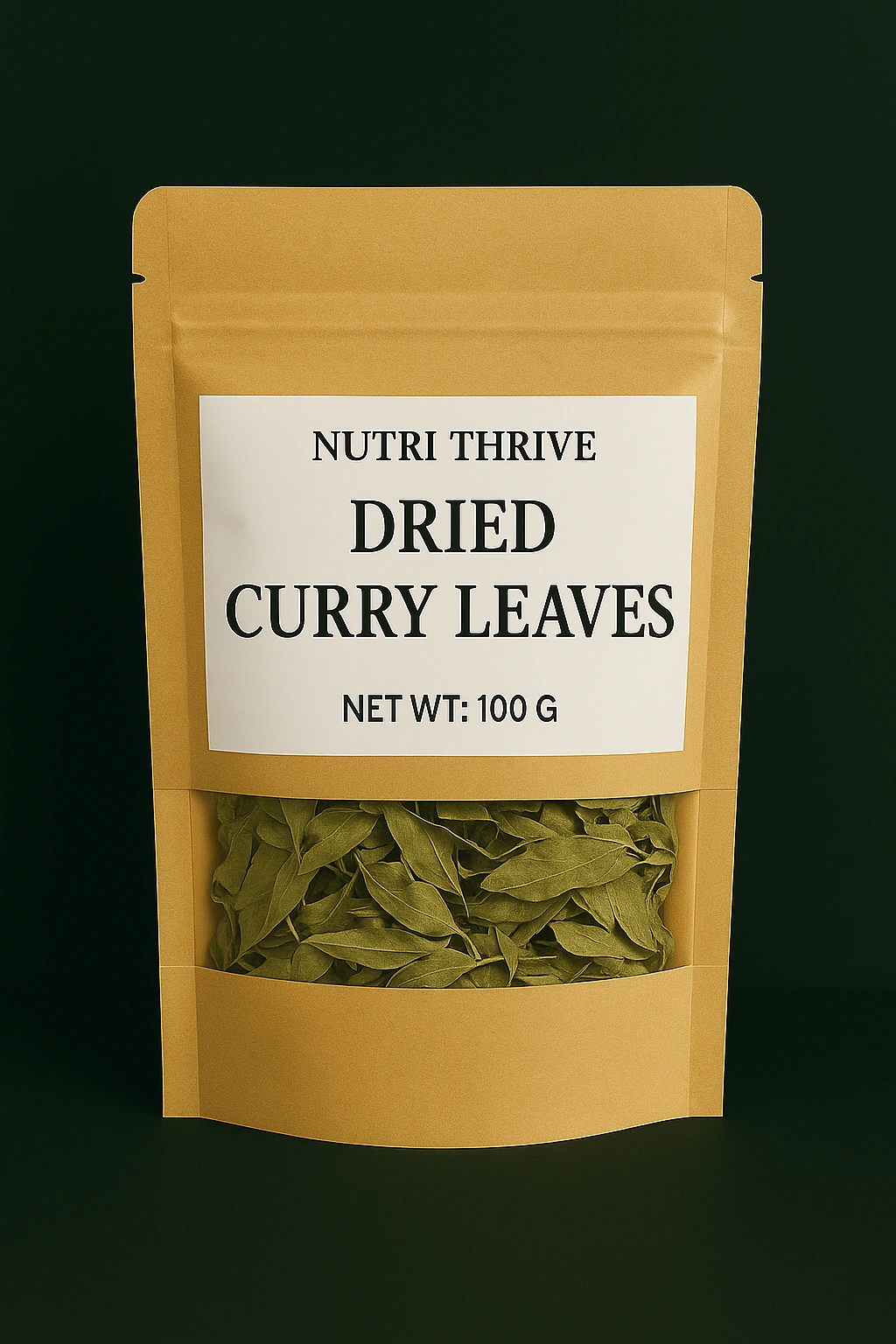
- Dried curry leaves, same leaf; use about 2 to 3× the volume of fresh, then fry in hot oil
- Kaffir lime leaves, closest aromatic match for tempering when you have none of the real leaf
- Lemon zest, citrus note only; fine for a weeknight pinch, not for leaf-forward dishes
AU tip: Coles/Woolworths sometimes stock dried curry leaves; fresh is more reliable at Asian grocers. If you cook South Indian food more than once a month, shop dried curry leaves and skip the substitute scramble.
- Dried curry leaves are the same ingredient as fresh: use about 2 to 3 times the volume, then adjust by aroma.
- Kaffir lime leaves are the closest substitute when you have no curry leaves at all.
- Lemon zest captures the citrus note only; it is an approximation, not a full swap.
- Bay leaf, basil, and fenugreek leaves work only in specific dishes.
- Never substitute curry powder for curry leaves. They are unrelated ingredients.
- When the dish needs real curry-leaf aroma (sambar, rasam, coconut chutney), stop substituting, buy dried.
You’re mid-recipe and the ingredient list calls for curry leaves you don’t have. Here is a ranked guide to what actually works, with exact swap ratios, and a clear line for when a substitute is not good enough.
Curry leaf substitute comparison
| Substitute | Swap Ratio | Flavour Match | Best For | Avoid When |
|---|---|---|---|---|
| Kaffir lime leaves | 1 leaf per 4 to 6 curry leaves | High (citrus, aromatic) | South Indian tempering, Thai curries | You need the earthy herbal note alone |
| Dried curry leaves | About 2 to 3× the volume of fresh | Exact (same ingredient) | Any recipe calling for fresh leaves | Never: this is the best option if you have it |
| Lemon or lime zest | Zest of ½ lemon per 10 to 12 leaves | Partial (citrus only) | Quick weeknight curries, dal | Dishes where curry leaves are the star flavour |
| Bay leaf | 1 bay leaf per 8 to 10 curry leaves | Low (minty, no citrus) | Mild lentil dishes, background aroma | Sambar, rasam, coconut chutney |
| Fresh basil | 4 to 5 leaves per 10 curry leaves | Low (anise note only) | Mild Thai-adjacent dishes | Traditional South Indian recipes |
| Fenugreek leaves (methi) | 1 tsp chopped per 8 to 10 leaves | Low (bitter, earthy) | North Indian dals where methi already fits | South Indian tempering, coconut-based dishes |
| Curry powder | Never use | None | Not applicable | Always: it is a ground spice mix, not leaves |
What you’re trying to replace
Curry leaves contribute a very specific aromatic quality: citrusy, slightly smoky, deeply herbal, that releases when whole leaves are briefly fried in oil. That aromatic quality is genuinely hard to replicate precisely, which is why every substitute involves some compromise.
Substitutes that actually work for curry leaves
1. Kaffir lime leaves (the best substitute). Kaffir lime leaves (also called makrut lime leaves) have a similarly intense citrusy aromatic quality and are used in analogous ways: whole leaves added to cooking rather than ground up. Use one kaffir lime leaf for every 4 to 6 curry leaves the recipe calls for; they’re more intense. Asian grocery stores carry them fresh or frozen.
2. Dried curry leaves. If the recipe calls for fresh curry leaves and you have dried, this is the simplest solution, and the one that stops being a “substitute”. Start with about two to three times the volume of dried leaves, then adjust by aroma once they hit the oil. Same technique: fry in hot oil at the tempering step. See fresh vs dried curry leaves for flavour and storage detail.
3. Lemon zest or lime zest. Citrus zest captures one dimension of what curry leaves do: the citrus note, without the earthy herbal character. Use the zest of half a lemon or lime for every 10 to 12 curry leaves. Add to the oil at the same point the recipe would have you add the leaves. It’s an approximation, not a match.
Substitutes that only sort of work in a pinch
Bay leaves. Bay leaves are used in similar ways (whole leaf in hot oil, removed before serving) but have a completely different flavour: more minty and bitter, no citrus quality. They don’t replicate curry leaves but they do add an aromatic backdrop. Better than nothing for some dishes; wrong for sambar, rasam, or anything where curry leaf aroma is central.
Fresh basil (in some contexts). Fresh basil has a slightly anise-like quality that can, in very mild curry dishes, approximate one note of curry leaves. Not a good substitute for South Indian dishes where curry leaves are prominent; might work in a milder Thai-adjacent context.
Fenugreek leaves (methi). Fresh or dried fenugreek leaves add a bitter, earthy note that appears in some North Indian dals alongside other aromatics. They do not taste like curry leaves, but in a methi dal or similar dish they can fill an herbal gap when curry leaves are unavailable. Do not use them in South Indian coconut or tamarind dishes.
What not to use instead of curry leaves
Never use curry powder as a curry leaf substitute. Curry powder is a ground blend of turmeric, coriander, cumin, and other spices. Curry leaves are whole leaves from the Murraya koenigii tree. Swapping one for the other changes the dish entirely and will not produce curry leaf aroma. See our curry leaves vs curry powder explainer for the full difference.
Also skip turmeric on its own, ground coriander, or generic “curry spice” mixes. None of these replicate curry leaf aromatics.
When a substitute is not good enough — buy dried curry leaves
Substitutes are for one dinner. They fail when curry leaves are the flavour the dish is built around.
Buy dried curry leaves instead of substituting when:
- You are cooking sambar, rasam, or coconut chutney, lime leaf or zest changes the character; omit is better than a bad swap, dried leaves are better than omit.
- You cook South Indian, Sri Lankan, or Malaysian food more than once a month, the substitute hunt becomes a recurring tax.
- You live outside easy Indian-grocery reach, dried leaves last months sealed; fresh bunches wilt in days.
- Your “substitute” keeps tasting like lemon or bay, not curry leaf, that is the signal the swap has hit its limit.
A one-off substitute still helps if: you are mid-recipe tonight, the supermarket has no curry leaves, and the dish can tolerate a citrus or herbal approximation (mild dal, weeknight curry with many other spices).
Honest path: keep a 30g pouch in the pantry. That is not a workaround, it is the same leaf, ready for tadka. Shop dried curry leaves ($7 / 30g). Free AU shipping from $79 if you mix with tea or a gift pack.
Dried curry leaves vs fresh — pantry reality
For flavour, heat, and oil tadka differences, see /blog/fresh-vs-dried-curry-leaves-cooking-comparison-2026
Buying dried leaves in Australia: /blog/dried-curry-leaves-australia-guide
Who this helps
This guide helps you if: you are cooking a recipe that calls for curry leaves and your local supermarket does not stock them; you want a one-off substitute for a single dish; or you are deciding whether to omit the ingredient entirely.
Skip the substitute loop if: authentic curry-leaf aroma matters to you regularly. That is when shop dried curry leaves is the practical Australian answer, not another bay leaf experiment.
Common mistakes when substituting curry leaves
- Using curry powder. The most common error. Curry powder and curry leaves share a name but nothing else. Never swap them.
- Adding lemon zest too early. Zest burns in hot oil. Add it at the same moment you would add curry leaves, and only for 30 to 60 seconds.
- Using too much bay leaf. One bay leaf goes a long way. More than one in a small dish tastes medicinal.
- Substituting in signature dishes. For sambar, rasam, or coconut chutney, omit the leaves rather than force a poor substitute.
- Skipping the frying step. Curry leaves (and most substitutes) release aroma in hot oil. Adding them raw at the end misses the point.
- Confusing dried and stale. Old dried leaves lose aroma. If yours smell like cardboard, replace them rather than doubling the quantity.
Cook with our dried curry leaves, free AU shipping over $79 when you mix with Darjeeling tea or the gift pack.
FAQ: curry leaf substitutes for Australian kitchens
Best substitute for curry leaves?
Dried curry leaves beat any substitute if you can get them, same ingredient. Kaffir lime leaves are closest when you have none. Lemon zest is the most accessible backup.
Can I use curry powder instead?
No. Curry powder is a spice blend. Curry leaves are whole leaves with a distinct citrus-herbal aroma. They cannot be swapped. See our curry leaves vs curry powder guide.
Can I skip them?
Yes. Omit rather than substitute with something that changes the dish character, especially for sambar, rasam, or coconut chutney.
Dried vs fresh?
Direct substitute. Start with about two to three times the volume of dried leaves versus fresh, then adjust by aroma. Fry in hot oil the same way. More detail in fresh vs dried curry leaves.
Do fenugreek leaves work?
Only in specific North Indian dishes where methi already belongs. Not a general substitute for South Indian tempering.
Can bay leaves replace curry leaves?
Partially, in mild dishes only. Use 1 bay leaf per 8 to 10 curry leaves. Avoid in dishes where curry leaf flavour is central.
When should I just buy dried curry leaves?
When you cook with curry leaves often, or when a citrus/herbal swap keeps failing the dish. A sealed pantry pouch removes the mid-recipe scramble. Shop dried curry leaves.
Written by Neer. NutriThrive Australia.
Shop dried curry leaves → · Fresh vs dried curry leaves → · How to store curry leaves →
Skip the substitute next time
Keeping a pouch of shade-dried curry leaves in the pantry means you skip the substitute problem entirely. Same ingredient as fresh, lasts months sealed, and fries the same way in tempering oil.
Update log
- 29 Jun 2026: Article published.
- 22 Jul 2026: Added quick answer, comparison table, expanded FAQs, and common mistakes section.
- 30 Sep 2026: CTR title/meta; deepened buy-dried and dried-vs-fresh H2s; primary CTA Shop dried curry leaves.

A practical next step
Dried Curry Leaves
Farm-grown karipatta from our own farm.
$7.00 / 30g