 NutriThrive
Dried Curry Leaves Australia: Buy, Store & Use Guide (2026)
Everything to know about dried curry leaves in Australia, how to store them, how to temper them, and where to buy fresh-tasting leaves online.
Quick Answer
Dried curry leaves are a reliable Australian pantry staple when fresh sprigs are hard to find. Store them airtight, cool, and dark for 6–12 months of good flavour. Temper them in hot oil or ghee (tadka) before the rest of the dish — that’s how the aroma actually shows up. Buy whole dried leaflets, not powder, from a source that packs them fresh.
- Dried leaves are quieter raw than fresh, but bloom in hot oil — tempering is non-negotiable for best flavour.
- Airtight + cool + dark keeps quality for roughly 6–12 months after opening.
- Use about 2–3× the volume of dried leaves vs fresh, then adjust by smell.
If you cook South Indian food in Melbourne, Sydney, or anywhere else in Australia, curry leaves (karuveppilai / karipatta) are one of those ingredients that either make the kitchen smell right — or leave the dish tasting oddly unfinished. Fresh sprigs are ideal when you can get them. Most weeks, though, dried curry leaves are what actually stay in the house. This guide covers what they are, how to store them, how to temper them properly, what nutrition claims are (and aren’t) worth repeating, and where to buy leaves that still taste like leaves.
What dried curry leaves are (vs. fresh)
Dried curry leaves are leaflets from the Murraya koenigii tree with most of the moisture removed — typically by shade-drying or gentle low-heat drying — so they keep for months instead of days. Fresh leaves are soft, bright green, and loud when you crush them between your fingers. Dried leaves are darker, brittle, and quieter on first sniff. That quieter aroma is not automatically a quality problem. Water carries a lot of the “just-picked” smell; once it’s gone, the oils behave more like a spice until heat wakes them up.
In Australian kitchens the fresh-vs-dried choice is often logistics, not ideology. Fresh curry leaves wilt quickly in humid weather, bruise in transit, and are inconsistently stocked outside larger Indian grocers. Dried leaves live next to mustard seeds and cumin and behave like a pantry staple. Fresh still wins for finishing, chutneys, and dishes where the leaf is the star. Dried wins for weekly dals, sambar, rasam, and any recipe where you need a reliable supply. If a recipe says “a handful of fresh leaves,” start with roughly two to three times that volume in dried leaves, then adjust once they hit the oil — smell beats a rigid gram conversion.
How to store them for 6–12 months
Flavour loss is the real enemy, not sudden spoilage. Keep dried curry leaves in an airtight jar or resealable pouch, away from the stove’s heat and out of direct sun. A cool, dark cupboard is enough for most Melbourne homes; you do not need the fridge. Refrigerators add moisture when packs are opened and closed, and moisture is what turns crisp leaves soft and dull.
Buy whole leaflets when you can. Powdered curry leaf loses aroma faster and is harder to judge for freshness. After opening, aim to finish the pack within 6–12 months for peak taste. If the leaves smell dusty, cardboard-like, or barely register when crushed, replace them — they’re still edible, but they won’t do much in a tadka. Label the jar with the open date if you’re the kind of cook who forgets when the last Coles bag went in.
How to temper / use them in cooking (tadka method)
Tempering — tadka, thaallipu, baghaar — is the step that makes dried curry leaves taste like themselves. Hot fat dissolves and carries the aromatic compounds; without it, dried leaves can taste flat even when the pack is fresh. Here’s a practical method that works for dal, sambar, vegetable stir-fries, and many Australian weeknight curries.
Step-by-step tadka with dried curry leaves
- Measure the fat. Use 1–2 tablespoons of neutral oil, coconut oil, or ghee in a small pan. Ghee browns spices faster; coconut oil suits South Indian profiles.
- Heat until shimmering. Medium heat is safer than screaming-hot. You want oil hot enough that a mustard seed sizzles immediately, not oil that smokes and scorches leaves in two seconds.
- Add hard spices first. Mustard seeds, cumin, or fenugreek usually go in before curry leaves. Wait for mustard seeds to pop or cumin to darken slightly.
- Add the dried curry leaves. Drop in a small handful (start with 8–15 whole leaflets for a pot of dal for 3–4 people). They should sizzle and turn a shade darker within 10–20 seconds. Stir so none sit in a hot spot and burn.
- Optional aromatics. Add sliced garlic, dried red chilli, or hing (asafoetida) if the recipe uses them. Work quickly — garlic burns easily after the leaves.
- Pour over the dish. Tip the entire tadka into simmering dal, rasam, or vegetables. Scrape the pan so the flavoured oil comes too. That oil is half the point.
- Rest briefly. Let the pot sit off the heat for a minute so the aroma settles into the liquid before you taste and salt-adjust.
Common mistakes: adding leaves to cold oil (they stew instead of bloom), overcrowding the pan so temperature crashes, and cooking them so long they turn bitter black. If your leaves smell excellent in the jar but disappear in the dish, you’re usually under-oiling or under-heating — not buying the wrong product.
Beyond classic dal tadka, dried curry leaves work in coconut chutney bases, lemon rice, potato stir-fries, egg curry, and even a quick scramble. For more recipe ideas beyond dal, see our guide to five ways to use curry leaves beyond dal. The same tempering logic applies: fat + heat first, then build the dish around that flavour. If you want a weeknight template, our 30-minute curry leaf dahl is built around this exact tadka sequence.
One more practical tip for Australian stoves: induction and flat ceramic cooktops heat oil fast and evenly, which is good — until the first mustard seeds burn while you’re still measuring leaves. Prep the curry leaves in a small bowl before the oil goes on. Gas gives you a clearer visual of flame, but the rule is the same: have the leaves ready, then cook them for seconds, not minutes. If you’re batch-cooking Sunday dals for the week, make a double tadka in a second pan and divide it — reheating already-tempered leaves in the microwave will not recreate the aroma of a fresh pour-over.
Quick reference: dried vs fresh in the pan
| Factor | Fresh | Dried |
|---|---|---|
| Raw aroma | Strong | Mild until heated |
| Best use | Finishing, chutneys | Tadka, weekly cooking |
| Shelf life | Days in the fridge | 6–12 months sealed |
| Amount | Recipe as written | ~2–3× volume, then adjust |
Nutrition context — plain, no inflated claims
Curry leaves contain plant compounds (including various polyphenols) and small amounts of micronutrients when eaten as food. That does not make a tadka a supplement, a detox, or a treatment for anything. In a normal Australian serving — a spoonful of tempered leaves in a family pot of dal — you’re getting flavour first and modest plant matter second. Marketing that frames curry leaves as a miracle herb usually skips dose reality.
Eat them as part of ordinary cooking. If you’re managing a medical condition, talk to your GP or an Accredited Practising Dietitian — food blogs are not clinical advice. We keep claims on this page culinary and practical on purpose. Curry leaf tea and hair-oil folklore circulate online; those uses sit outside everyday cooking and are not what this buying guide is for.
Where to buy dried curry leaves in Australia
You can find dried curry leaves at Indian grocery stores, some Asian grocers, and online specialty shops. Quality varies more than people expect. Look for:
- Whole leaflets, not grey-green powder that smells of cardboard
- A clear pack date or batch so you’re not buying warehouse leftovers
- Airtight packaging that still feels crisp when you open it
- Colour that still looks green-olive, not uniform brown dust
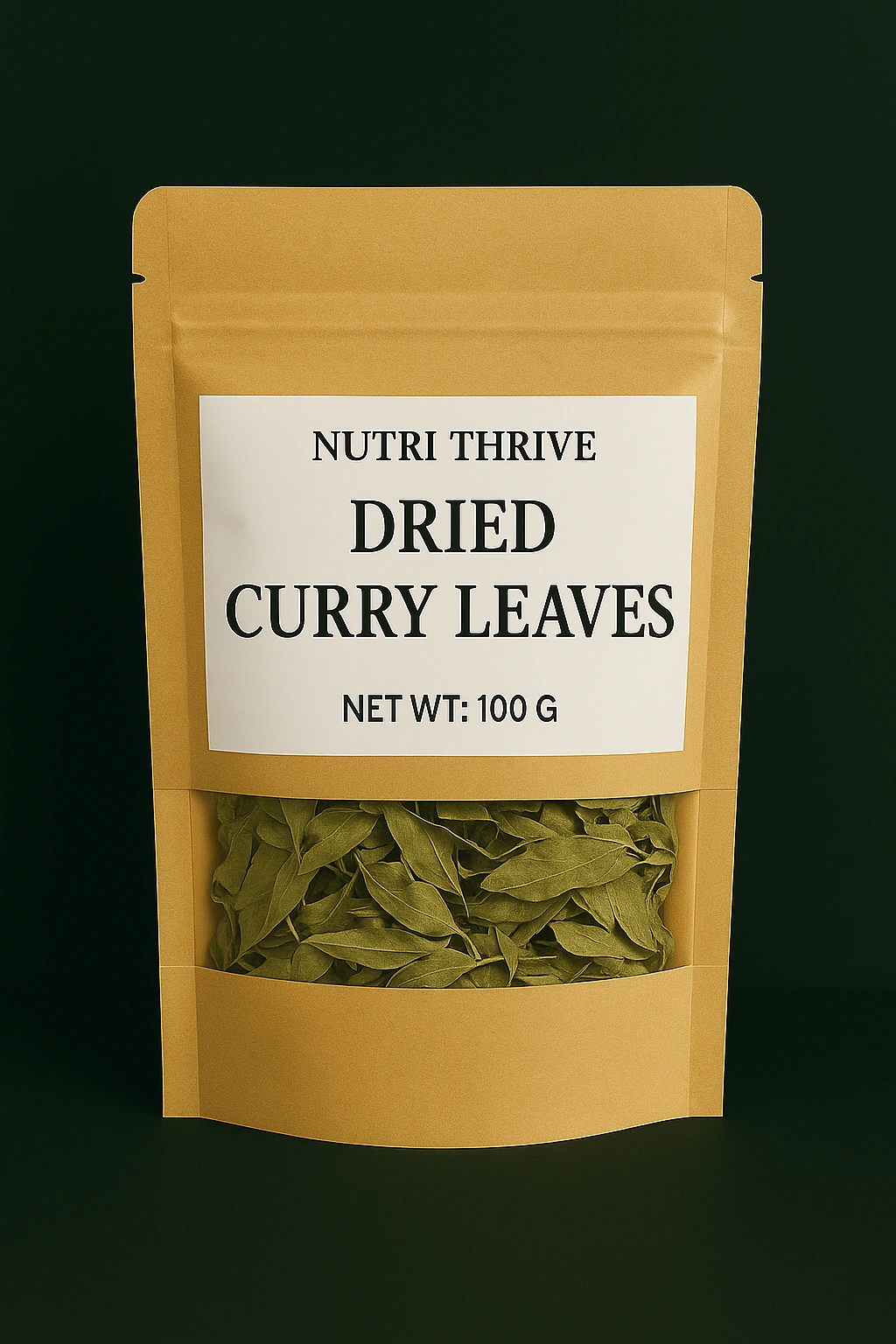
At NutriThrive we pack shade-dried curry leaves in 30g pouches from Truganina (Melbourne’s west) for $7. Free shipping applies on Australian orders over $79 (international free-shipping threshold is $90). Orders placed before 2pm on business days aim for same-day dispatch. If you’re stocking a pantry for regular South Indian cooking, 30g goes further than it sounds once you’re tempering by the handful rather than by the stem. Pairing curry leaves with a staple you already reorder (dal lentils from your grocer, or tea from the same parcel) is the easiest way to clear the free-shipping threshold without buying spice you will not use.
Buying tips if you’re comparing shops: avoid packs that look like crushed powder with a few leaf shards mixed in; prefer visible whole leaflets; and be wary of jars that have sat on a bright shelf for months — light and heat age aroma the same way they age paprika. Online packing from a small Melbourne batch is often fresher than a forgotten supermarket jar, but only if the seller actually turns stock over. When in doubt, crush one leaf when the pack arrives. If the smell is immediate and green-herbal, you’re set. If it smells like dust, contact the seller or replace the pack before you blame your recipe.
Shop dried curry leaves
Whole leaflets, packed in Melbourne. $7 / 30g. Same-day dispatch before 2pm.
Cook with our dried curry leaves, free AU shipping over $79 when you mix with moringa powder or Darjeeling tea.
FAQ
Are dried curry leaves as good as fresh?
For everyday cooking and tempering, good dried leaves are excellent. Fresh leaves smell louder when raw, but dried leaves bloom in hot oil and keep for months — which matters more for most Australian home cooks.
How much dried curry leaf equals fresh?
Start with about two to three times the volume of dried leaves versus fresh, then adjust by aroma once they hit the oil. Recipes vary; smell is a better guide than a rigid gram conversion.
Do dried curry leaves expire?
They do not suddenly go unsafe if kept dry, but flavour fades. Aim to use an opened pack within 6–12 months for the best taste. If they smell dusty or cardboard-like, replace them.
Can I use dried curry leaves without tempering?
You can stir them into simmering dals or soups, but tempering in hot oil or ghee unlocks far more aroma. Skipping tadka usually tastes flatter.
Where can I buy dried curry leaves online in Australia?
Look for whole dried leaflets (not powder), a recent pack date, and airtight packaging. NutriThrive ships 30g shade-dried curry leaves from Melbourne for $7, with free shipping over $79 within Australia.
Written by Neer. NutriThrive Australia.
General food and cooking information only — not medical advice. These statements have not been evaluated by the TGA.
Further reading: Dried curry leaves product page · Curry leaves recipes beyond dal · 30-minute curry leaf dahl · Fresh vs dried comparison
Update log
- 13 Aug 2026: Article published.

Ready for the pantry
Dried curry leaves from our farm
30g of shade-dried kari leaf, grown on our farm in Gujarat and packed in Truganina. Use about 2 to 3 times as much as fresh.
$7.00 / 30g